County Board of Supervisors - District 4
Question 1:
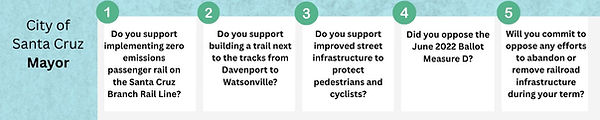
The Regional Transportation Commission owns the rail corridor. The RTC has unanimously affirmed its commitment to institute high capacity public transit service on the Santa Cruz Branch Line. Do you support implementing electric passenger rail on the Santa Cruz Branch Rail Line?
Yes
Why or why not? How would this position be expressed in your work, should you be elected?
I support zero-emissions passenger rail as part of a broader, integrated, and community-centered transportation system. Santa Cruz County needs reliable, affordable alternatives to car dependency that reduce emissions and improve connectivity across the region.
That said, implementation must be accountable to our community. It should be phased, financially responsible, and coordinated with expanded bus service, bike, and pedestrian infrastructure so it serves those who need it most, including working families, students, and South County residents.
If elected, I will ensure investments in rail do not come at the expense of immediate transit needs and that community voices, especially from Watsonville, are meaningfully included. Our goal should be a system rooted in equity, sustainability, and real public benefit.
Question 2:
Construction has begun on the trail next to the tracks, but some segments have faced opposition and resulting delays. Do you support building a trail next to the tracks from Davenport to Watsonville?
Yes.
How would this position be expressed in your work, should you be elected? What will you say to your constituents about this project?
I support completing the trail from Davenport to Watsonville as a safe, accessible, and community-centered investment in active transportation. The trail is already underway in many segments, and completing it will improve connectivity, public health, and access to our coast for residents across the county.
At the same time, I recognize that some segments have raised concerns. My approach is to ensure continued community engagement, transparency, and thoughtful implementation that addresses local impacts while keeping the broader public benefit in focus.
If elected, I will advocate for completing the trail in a way that prioritizes safety, accessibility, and equity, especially for South County residents who have historically had less access to coastal resources. I will also continue to support a balanced approach that advances both the trail and future transit options along the corridor.
Question 3:
Neighborhoods with safe streets, bike lanes, and sidewalks create room for us to move freely without our cars. Do you support improved street infrastructure to protect pedestrians and cyclists?
Yes.
How would you support or prioritize projects, policies and funding to improve safety and infrastructure for pedestrians and cyclists?
I support improving street infrastructure to protect pedestrians and cyclists as a core public safety and quality of life issue. Safe streets mean people can move freely, access jobs, schools, and services, and feel a sense of belonging in their community.
If elected, I will prioritize funding for projects that expand sidewalks, protected bike lanes, safe crossings, and traffic calming, especially in historically underserved areas like Watsonville. I support leveraging state and federal grants, including Active Transportation Program funds, to bring resources into our county.
I will also advocate for community-informed planning, ensuring residents help shape projects in their neighborhoods. Safety investments should reduce harm without over-policing, focusing instead on design solutions that make our streets safer for everyone.
Question 4:
The June 2022 Greenway Measure D sought to “rail bank” and tear up the tracks for a trail only. Did you oppose the June 2022 Ballot Measure D?
Yes (opposed).
What do you think are the implications of the 73% defeat of measure D?
I opposed Measure D because it would have removed the opportunity for future high-capacity public transit along the corridor. Once rail is removed, that option is effectively gone. Our community needs long-term solutions that reduce car dependency while also expanding access and mobility.
The 73% defeat of Measure D reflects a clear community mandate to preserve the rail corridor for future transit while continuing to advance the trail. Voters showed they support a balanced, forward-looking approach rather than limiting ourselves to a single-use solution.
Moving forward, this means we should focus on delivering both a completed trail and viable transit options, with accountability, transparency, and meaningful community input guiding implementation.
Question 5:
The California Coastal Commission recognizes the value of both freight and passenger rail in the coastal zone for environmental and coastal access reasons. Freight rail capability is important infrastructure for disaster preparedness and recovery.
Will you commit to oppose any efforts to abandon or remove railroad infrastructure during your term?
Yes.
How would this position be expressed in your work, should you be elected?
I will oppose efforts to abandon or remove railroad infrastructure because preserving the corridor protects long-term transportation options, supports climate goals, and maintains critical infrastructure for disaster preparedness and recovery.
Rail infrastructure is a public asset that, once removed, cannot be easily replaced. Preserving it keeps open the possibility for future passenger rail, supports potential freight use, and aligns with Coastal Commission priorities around environmental sustainability and coastal access.
If elected, I will express this by supporting policies and investments that maintain and enhance the corridor, while advancing a balanced approach that includes both the trail and future transit. I will also ensure decisions are guided by long-term public benefit, community input, and resilience planning.